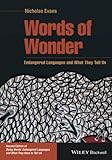
Words of wonder : endangered languages and what they tell us / Nicholas N. Evans.
By: Evans, Nicholas [author.]
Language: English Series: The language libraryPublisher: Hoboken, NJ : John Wiley & Sons, 2022Edition: Second editionDescription: xix, 297 pages : color illustrations ; 26 cmContent type: text Media type: unmediated Carrier type: volumeISBN: 9781119758754ISSN: 1119758750Uniform titles: Dying words Subject(s): Endangered languagesDDC classification: GS 408.9 E9283 2022 LOC classification: P40.5.E53 | E93 2022Summary: "In the oral traditions of northwestern Arnhem Land, the first human to enter the Australian continent was the ancestress Warramurrungunji, who came out of the Arafura Sea on Croker Island near the Cobourg Peninsula, having traveled from Macassar in Indonesia. Her first job was to sort out the right rituals so that the many children she gave birth to along the way could survive, and the hot mounds of sand, over which she and all women thereafter would have to purify themselves after childbirth, remain in the landscape as the giant sandhills along Croker Island's northern coasts. Then she headed inland, and as she went she put different children into particular areas, decreeing which languages should be spoken where. Ruka kundangani riki angbaldaharrama! Ruka nuyi nuwung inyman! 'I am putting you here, this is the language you should talk! This is your language!' she would say, in the Iwaidja version of the story, naming a different language for each group and moving on. The Judeo-Christian tradition sees the profusion of tongues after the Tower of Babel as a negative outcome punishing humans for their presumption, and standing in the way of cooperation and progress. But the Warramurrungunji myth reflects a point of view much more common in small speech communities: that having many languages is a good thing because it shows where each person belongs. Don Laycock quotes a man from the Sepik region of Papua New Guinea saying 'it wouldn't be any good if we all talked the same; we like to know where people come from.' The Tzotzil oral traditions of the Mexican Chiapas give another twist to this tune: 'while the sun was still walking on the earth, people finally learned to speak (Spanish), and all people everywhere understood each other. Later the nations and municipios were divided because they had begun to quarrel. Language was changed so that people would learn to live together peacefully in smaller groups.'"-- Provided by publisher.| Item type | Current location | Home library | Collection | Call number | Status | Date due | Barcode | Item holds |
|---|---|---|---|---|---|---|---|---|
 Book
Book
|
Sibalom | Sibalom MGS | Main-Graduate Library | GS 408.9 E9283 2022 (Browse shelf) | Available | UAMAIN 35917 |
Browsing Sibalom Shelves , Shelving location: MGS , Collection code: Main-Graduate Library Close shelf browser

|
|
|

|

|

|

|
||
| GS 407.041 L26 1994 The language issue in education | GS 407.041 L26 1994 The language issue in education | GS 407.041 L26 1994 The language issue in education | GS 408.9 E9283 2022 Words of wonder : endangered languages and what they tell us / | GS 418.0071 L8481 2015 Second language acquisition and task-based language teaching | GS 425 L16s 1997 Sentence skills with readings | GS 425 P43e 1992 English in a new perspective (book 1) |
Revised edition of: Dying words. 2010.
Includes bibliographical references and index.
"In the oral traditions of northwestern Arnhem Land, the first human to enter the Australian continent was the ancestress Warramurrungunji, who came out of the Arafura Sea on Croker Island near the Cobourg Peninsula, having traveled from Macassar in Indonesia. Her first job was to sort out the right rituals so that the many children she gave birth to along the way could survive, and the hot mounds of sand, over which she and all women thereafter would have to purify themselves after childbirth, remain in the landscape as the giant sandhills along Croker Island's northern coasts. Then she headed inland, and as she went she put different children into particular areas, decreeing which languages should be spoken where. Ruka kundangani riki angbaldaharrama! Ruka nuyi nuwung inyman! 'I am putting you here, this is the language you should talk! This is your language!' she would say, in the Iwaidja version of the story, naming a different language for each group and moving on. The Judeo-Christian tradition sees the profusion of tongues after the Tower of Babel as a negative outcome punishing humans for their presumption, and standing in the way of cooperation and progress. But the Warramurrungunji myth reflects a point of view much more common in small speech communities: that having many languages is a good thing because it shows where each person belongs. Don Laycock quotes a man from the Sepik region of Papua New Guinea saying 'it wouldn't be any good if we all talked the same; we like to know where people come from.' The Tzotzil oral traditions of the Mexican Chiapas give another twist to this tune: 'while the sun was still walking on the earth, people finally learned to speak (Spanish), and all people everywhere understood each other. Later the nations and municipios were divided because they had begun to quarrel. Language was changed so that people would learn to live together peacefully in smaller groups.'"-- Provided by publisher.
400-499 Language
There are no comments for this item.